Big questions deserve better answers.
Vividly illustrated books that give curious readers, families, and teens
clear, honest answers—delivered by a wry, amusing narrator that inspires you to keep reading.
Start with the short answer. Stay for the fascinating story underneath.

Street-Smarts for Teens
Real-life judgment for the situations adults can’t always be there for.
101 real answers to help teens handle tricky situations, recognize pressure and red flags, stay safer, and think clearly when the right move isn’t obvious.
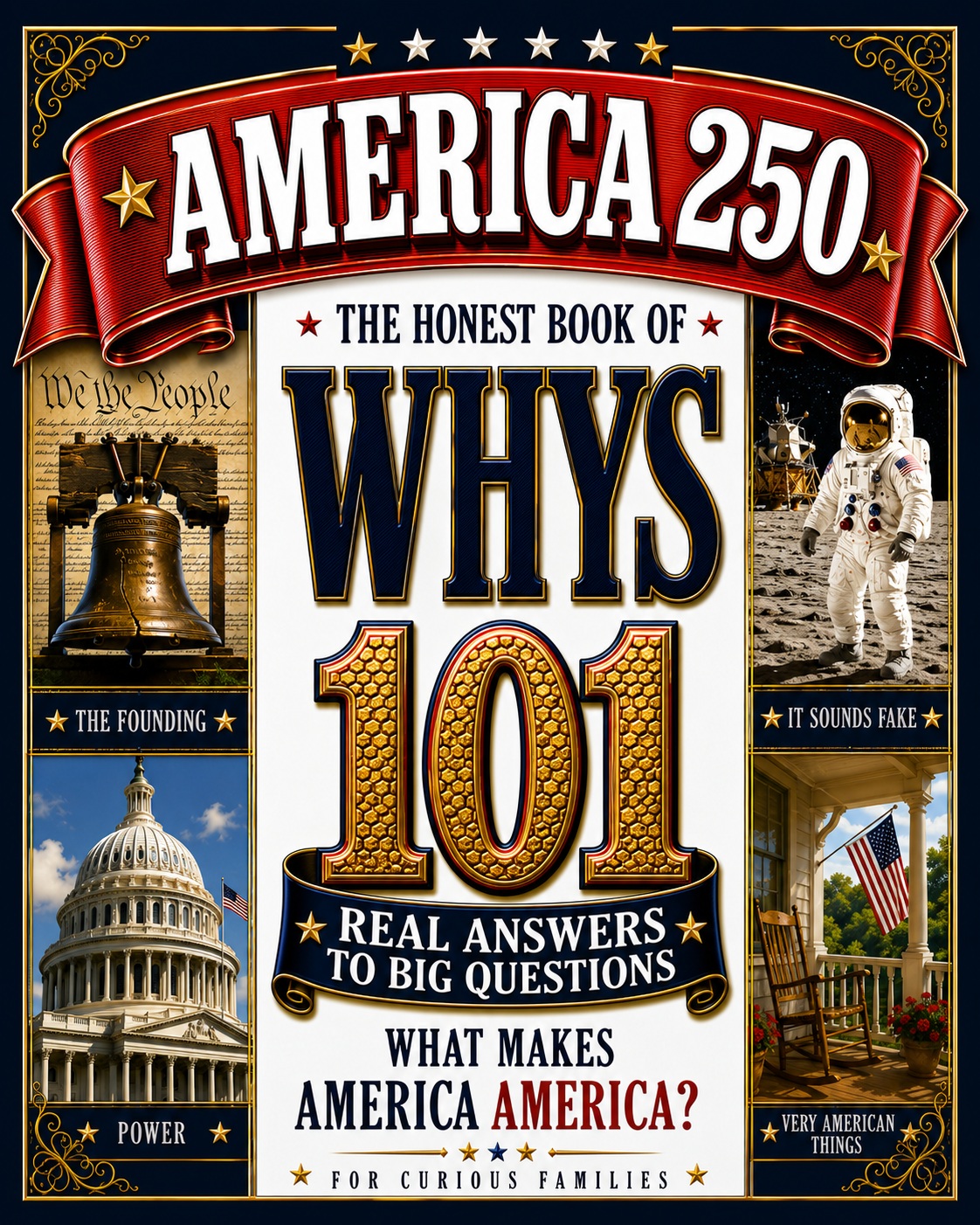
America 250: What Makes America America
Celebrate America, and understand the whole story.
101 honest answers to the questions behind America: the inspiring parts, the strange parts, and the difficult parts people still debate.

The Honest Book of Whys for Curious Kids
The human body, weird history, and hard stuff too.
101 real answers to the big questions kids ask about space, daily mysteries, animals, technology, and more. Engaging for kids, and substantial enough for adults reading along.
Not 100,000 whys. Just the right ones.
Each book takes one big topic and breaks it into 101 questions people genuinely wonder about, then answers them properly, with the hard parts left in.
Carefully curated questions
101 questions chosen because they’re genuinely worth asking, not padding to hit a number.
Clear answer first
A short, direct answer up front. Then the real story underneath, for anyone who wants to keep going.
Richly visual storytelling
Illustrated throughout, so a book you can wander becomes a book you keep opening.
A narrator with personality
Smart, dry, and occasionally mischievous—never lecture-like.
Start with the question. Get the short answer. Go deeper.
Every book begins with questions people genuinely wonder about, gives the answer first, then goes deeper with the story, science, history, psychology, or real-life reasoning underneath.
Click any page to read it full size.
Street-Smarts
for Teens
Real-life judgment for situations adults cannot always be there for.

Every room starts with real life.

Visual features that teach and stick.

Short answer first. Then the reasoning.
America 250
The founding, the myths, and the parts people still argue about.

Every section opens with a map of what is inside.

Weird, little-known, and fascinating.

Straight answer first. Then the full story.
The Honest Book of Whys
for Curious Kids
Space, animals, the human body, weird history, and everyday mysteries.

Big topics made visual and memorable.

Questions kids love, and adults do too.

Short answer first. Then the details.
What readers are saying.
“The questions are fascinating, the answers are honest and age-appropriate, and the design keeps kids engaged from page to page.”
“An absolute hit with my son… engaging, age-appropriate, and the best of the bunch.”
“My 10-year-old immediately said, ‘It looks so cool.’ The pages are thoughtfully designed and pleasant to read.”
“My 10-year-old loves reading the facts and sharing them with everyone. The short answers and deeper explanations keep him engaged.”
“A brilliant American history resource… honest, respectful, visually engaging, and worth returning to again and again.”
“Well written, informative, and suitable for the entire family. Great for adults and children alike.”
“A fun and educational way to learn American history. My kids enjoyed learning bits of history from it.”
“The questions are so good you don’t realize you want to know the answers. I’m 54 and loved it.”
“This is an incredible book for teens! It tackles tough questions that a teen may not even know they need to ask, and it does it in plain language with realistic examples.”
“Great book with a lot of good information for teens. It acts as a guide for young adults to navigate through difficult decisions.”
“Great read for teens to get some basic skills down they need to succeed in life.”
Where the “whys” come from.
Whether the tradition reaches you as 100,000 Whys, 1000 Whys, 100 Whys, or just “that big book of whys,” this is the honest, carefully curated version.
Read the full origin story →
Billie Alexander
Billie Alexander writes The Honest Book of Whys, a series that answers the questions people actually ask: clearly, honestly, accurately, and without the lecture.
Each volume is an illustrated, question-led mini-encyclopedia built around 101 real questions about the human body, outer space, American history and more. No required reading order, no filler: open to any page and get a real answer, researched carefully enough that the adult reading over their shoulder might learn something too.
On the harder questions, the ones that get dodged or simplified, the approach stays the same: explain how things actually work, be honest about what’s still debated, and trust readers to draw their own conclusions.
“When not asking ‘why,’ Billie is usually researching the next question that deserves an honest answer.”
Which book are you curious about?
Keep in touch with Billie.
More books are on the way. Hear about them first, and tell Billie what she should dig into next.
Get word on the next book
New releases, sample pages, and the occasional weird fact. That’s it. No spam.
What should Billie explain next?
A topic, a question, a “why” you’ve always wondered about. She reads every one.